




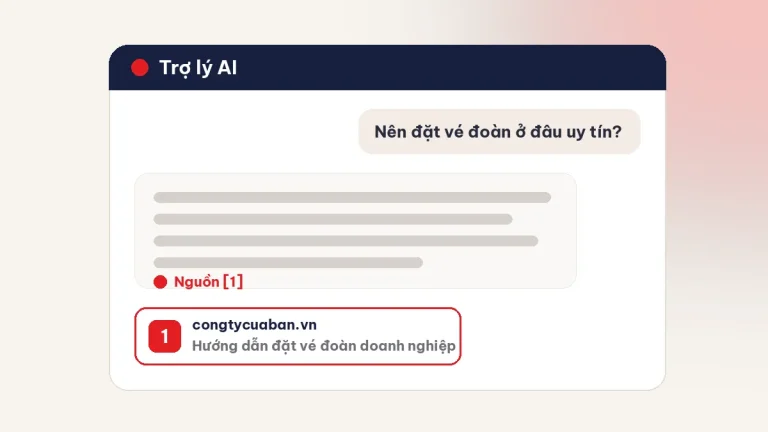
To get cited by AI Overviews and other AI tools, write so that each paragraph fully answers one question and still makes sense when pulled out of the article. Put the answer in the first sentence of the paragraph, give figures with sources and dates, put comparisons in tables, and make author and business information clear. Google says there is no special optimization for AI Overviews; the seven techniques below are simply a clearer way of writing, for both human readers and machines.
How does AI choose paragraphs?
According to Google's documentation, AI Overviews and AI Mode may use a "query fan-out" technique: splitting the user's question into several smaller queries by sub-topic, then finding sources for each part. The implication for writers: your article may be used to answer a sub-question rather than the main question. A paragraph that answers a sub-question concisely has a chance.
7 writing techniques
Technique 1: Put the answer in the first sentence
Open each section with a direct answer, then explain, give examples, and note exceptions.
Before: > While traveling by air, many passengers have questions about online check-in. This is an increasingly popular feature, and to use it, we need to note certain time limits…
After: > Vietnam Airlines online check-in opens 24 hours before and closes 1 hour before the scheduled departure time, according to the airline's online check-in page. If you have checked baggage, you still have to bring your suitcase to the counter before it closes.
The second version is shorter, has a number and a source, and makes sense on its own.
Technique 2: Self-contained paragraphs
Avoid "as mentioned above", "this", or "the second way" at the start of a paragraph. When AI pulls a paragraph out, these back-references lose their meaning. Name the subject each time it is needed.
Technique 3: Headings that are real questions
Write H2s and H3s the way customers ask: "Can I get taxes and fees back on a non-refundable ticket?" instead of "Some notes". Sources of questions: messages customers send, the website's search box, Google's "People also ask" section.
Technique 4: Figures with a source and date
Write "according to the airline's page as of October 2026" rather than just stating the number. If you have no firm figure, write in general terms. A wrong number cited by AI spreads faster than you can correct it.
Technique 5: Tables for comparisons, step lists for processes
When comparing two or more options across several criteria: use a table. For a process with an order: use a numbered list. Both skimming readers and machines pull information from this structure more easily than from long paragraphs.
Technique 6: Original information found nowhere else
Google encourages original content, not the kind of information found everywhere. For a business, the valuable original material is real experience: situations customers often run into, internal processes, common mistakes. For example, in the article on refunding and changing flight tickets, we recorded three money-losing situations that HVSC's ticket desk sees again and again. That is information a generic roundup is unlikely to have.
Technique 7: Who wrote it, when it was updated, who the business is
Give the author or editorial team, the publication date, and the update date. The About page has the legal entity name and address. Structured data (Article, Organization, FAQPage where appropriate) must match what is displayed on the page; Google stresses this match.
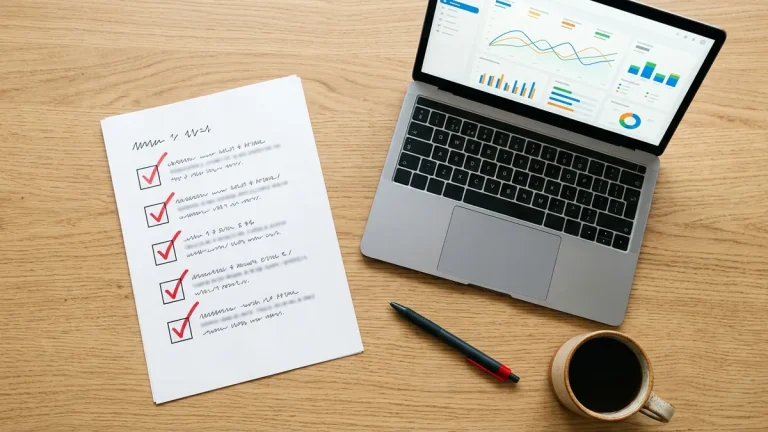
Self-check table for an article
| Question | Passes when |
|---|---|
| Reading the first 3 sentences, do you know the main answer? | Yes |
| If you pull out a random paragraph, does it make sense on its own? | Yes, without reading the previous paragraph |
| Does every number have a source and date? | Yes, or written in general terms when unsure |
| Is there at least one piece of information from original experience? | Yes |
| Are comparisons in tables and processes in steps? | Yes |
| Is there an author and an update date? | Yes |
| Is important content in text, not only in images? | Yes |
What not to do
- Stuffing fake questions into an FAQ just to add keywords. Readers skip them, and they do nothing for credibility.
- Rewriting one article into ten near-identical ones. This is exactly the kind of content Google's spam policies target.
- Putting key information in images or videos with no description. Google advises keeping important content as text.
- Blocking bots and then wondering why you are not cited. Check robots.txt, the firewall, and the CDN.
Controlling what is displayed
If a page has content you don't want to appear in Google's snippets or AI answers, you can use nosnippet, data-nosnippet, max-snippet or noindex. These tags also affect regular search results, so use them only deliberately. To limit how content is used for training and answers in other Google systems, see the documentation on Google-Extended.
Measuring results
Clicks from AI Overviews and AI Mode are included in the Search Console Performance report (Web search type) and are not separated out. A practical way to measure: track the pages you revised using the techniques above, compare impressions and clicks before and after a few weeks; periodically ask AI tools your customers' key questions and record the sources they cite.
Foundation concepts in this article What is GEO, the website technical part in checklist SEO 2026. If your business needs to re-edit its existing article library in this direction, send a request on the page content management.
Reference sources
- Google Search Central, AI features and your website: https://developers.google.com/search/docs/appearance/ai-features
- Google Search Central Blog, Top ways to ensure your content performs well in Google’s AI experiences on Search (5/2025): https://developers.google.com/search/blog/2025/05/succeeding-in-ai-search
- Google Search Central, Creating helpful, reliable, people-first content: https://developers.google.com/search/docs/fundamentals/creating-helpful-content
Want customers to find you on Google and AI?
Send your existing website or channel, and HVSC will do a quick review and suggest what to do first.
FAQ
Is there any way to force AI Overviews to cite my page?
No. Google says there is no special requirement or optimization for appearing in AI Overviews; the page must be indexed and eligible to show a snippet. You can only make your content clearer, more trustworthy, and easier to cite.
What if I don't want a passage to be included in an AI answer?
Google supports preview controls such as nosnippet, data-nosnippet, max-snippet, or noindex. Note that they also affect how the page appears in regular search results.
Is the FAQ at the end of an article still useful?
A well-written Q&A section helps readers and helps AI find short answers to sub-questions. Structured data, if used, must match the content displayed on the page.
Are long or short articles more likely to be cited?
Length is not the main factor. An article needs to be long enough to fully answer the question and related questions, with each part answering concisely, not stretched to hit a word count.






 ▶
 ▶
 ▶
 ▶
 ▶
 ▶