



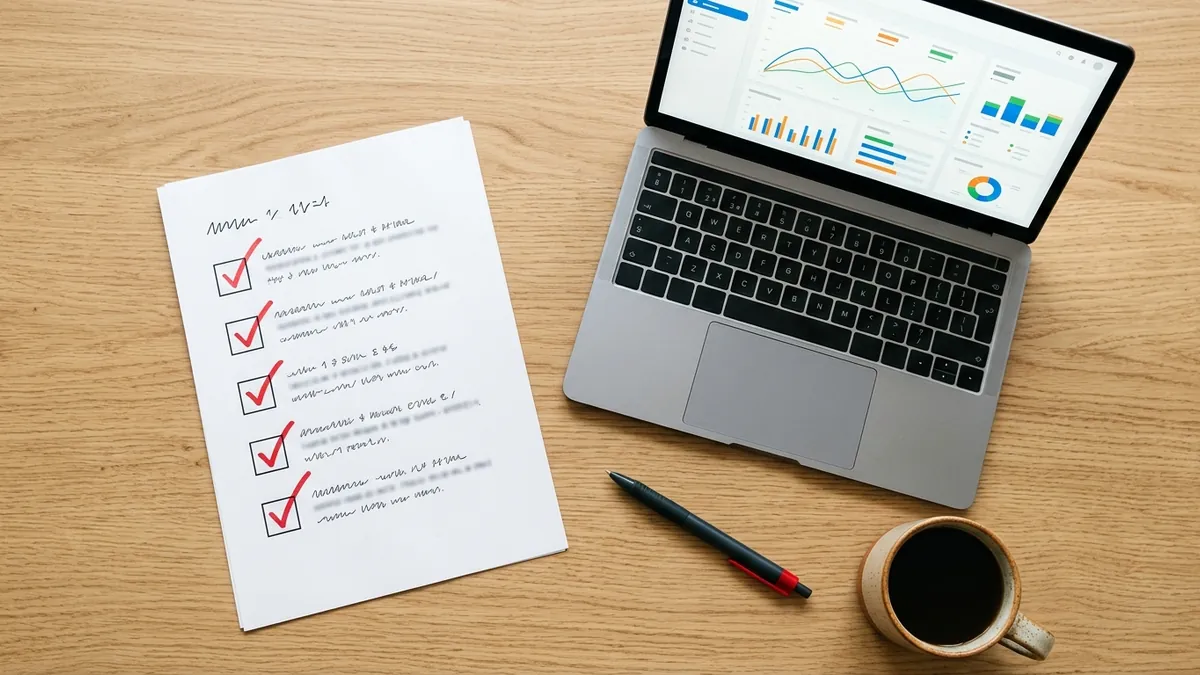
SEO in 2026 still revolves around three questions: can Google find and understand your pages, does the content truly help readers, and is the business trustworthy enough. What is new is that the same foundation now serves both regular search results and AI answers. The checklist below is divided into 5 groups of 6 tasks each, so you can review your website yourself in one afternoon.
Group 1: Technical (Google can find and read your pages)
- The website is verified in Google Search Console and Bing Webmaster Tools.
- There is an up-to-date XML sitemap with accurate modification dates (lastmod), submitted to both tools above.
- robots.txt does not accidentally block important folders; firewalls and CDNs do not block search bots.
- Each page has one canonical URL; the versions with and without "www", and "http" and "https", all redirect to a single address.
- The main content appears in the HTML, not only after JavaScript loads.
- Pass Core Web Vitals: LCP ≤ 2.5 seconds, INP ≤ 200 ms, CLS ≤ 0.1 at the 75th percentile (see the article Core Web Vitals).
Small tip: with Bing and some other tools, the IndexNow protocol lets you notify them immediately when you publish or edit a post, instead of waiting for the bot to come back.
Group 2: Content (helping readers)
Google describes its ranking systems as designed to prioritize helpful, reliable content created for people, not content made to manipulate rankings. Google's documentation suggests self-assessing with three questions: who created the content, how it was created, and why it was created.
- Each page answers one clear need, with the main answer at the top of the page.
- It has information of its own that other pages lack: real experience, internal processes, real examples.
- Figures and regulations have a source and an update date.
- There are no multiple near-identical pages competing for the same keyword.
- Old articles are reviewed and updated; outdated articles are merged or redirected.
- Do not mass-produce thin articles. Since March 2024, Google has added a spam policy on scaled content abuse, which applies whether the content is written by humans or AI.
Group 3: Credibility (a trustworthy business)
- The About page has the legal entity name, tax code, address, years in operation, and the person in charge.
- The Contact page has a phone number, email, and map; the information matches the Google profile.
- Articles have an author or editorial team name, publication date, and update date.
- There is a privacy policy and terms of service, especially if the website collects customer data.
- Customer reviews and feedback are genuine. Never write fake reviews yourself.
- Organization structured data links to the official social media pages.
Group 4: Local SEO (if customers come in person)
- The Google Business Profile is verified, with the correct category, opening hours, and real photos.
- Name, address, and phone number are written consistently across the website, Google, social media, and directories.
- Each branch has its own page with address, opening hours, and map.
- Addresses are updated to the new ward and province names after the administrative restructuring (if there were changes).
- Respond to Google reviews, including the less favorable ones.
- Office and store photos are real; do not use stock photos for this section.
Group 5: Measurement
- Search Console: track impressions, clicks, queries, and pages by month. Clicks from AI Overviews and AI Mode are counted together in the Performance report, under the Web search type.
- Google Analytics or an equivalent tool: measure conversions (form submissions, calls, orders), not just page views.
- Track visits referred from AI tools separately.
- A list of the 20 questions that matter most to customers; each quarter, ask the AI tools yourself whether the website gets mentioned.
- Report on pages that have lost traffic so the content can be refreshed.
- Record every major change (design, URLs, server) with its date, so you can cross-check when the numbers fluctuate.
Priorities when time is limited
If you can only do a few things, we suggest this order:
- Search Console, sitemap, robots: if the site cannot be indexed, everything else is meaningless.
- About page, Contact page, Google profile: cheap, fast, with clear impact for local businesses.
- Fix your 10 key pages: answer at the top, with sources, and a table where needed.
- Speed: top-of-page image, caching.
- Only then move on to writing new articles.
SEO and GEO
Once your SEO foundation is solid, the next layer is making your content easy for AI to cite. Read on at What is GEO and writing content to be cited by AI Overviews. If your website does not yet have a stable domain name or you are planning to change it, read the article first .vn or .com domain.
HVSC offers an SEO review service for business websites based on this checklist. Send your website address at the page SEO service to get a free quote.
Reference sources
- Google Search Central, Creating helpful, reliable, people-first content: https://developers.google.com/search/docs/fundamentals/creating-helpful-content
- Google Search Central, Spam policies (scaled content abuse): https://developers.google.com/search/docs/essentials/spam-policies
- Google Search Central, AI features and your website: https://developers.google.com/search/docs/appearance/ai-features
- web.dev, Core Web Vitals thresholds: https://web.dev/articles/defining-core-web-vitals-thresholds
- IndexNow: https://www.indexnow.org/
Want customers to find you on Google and AI?
Send your existing website or channel, and HVSC will do a quick review and suggest what to do first.
FAQ
Is SEO in 2026 still effective now that AI Overviews exist?
Yes. Google says that to appear in AI Overviews and AI Mode, a page needs to be indexed and eligible to be shown with a snippet in Search. That means foundational SEO is still the first condition.
Will Google penalize me for using AI to write articles?
Google does not ban the use of AI. What is treated as spam is mass-producing pages mainly to manipulate rankings without providing value to readers (scaled content abuse), whether written by humans or machines.
How often should I review the SEO checklist?
Review the technical side monthly in Search Console. Go through the whole checklist every quarter, or after every theme change, URL structure change, or server migration.
What else does a local business need to do?
A complete Google Business Profile with correct opening hours; name, address, and phone number consistent across the website and other sites; and a contact page with a map.








 ▶
 ▶
 ▶
 ▶
 ▶
 ▶