



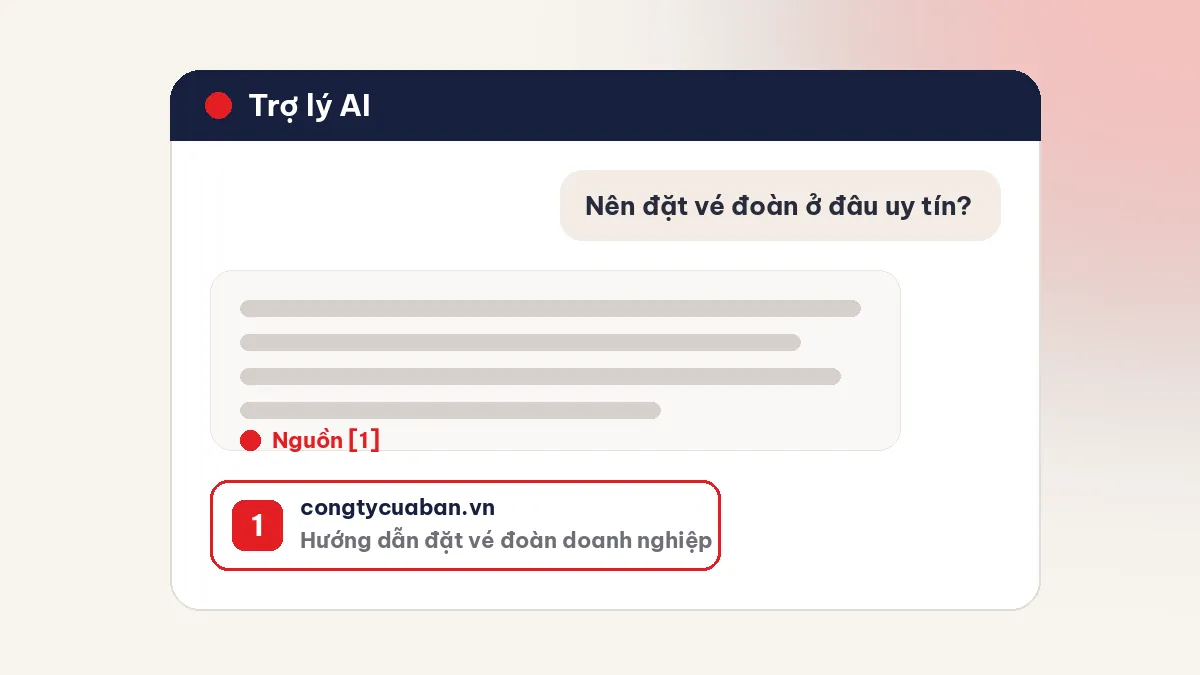
GEO (Generative Engine Optimization) is a way of writing and organizing website content so that AI answer tools, such as Google AI Overviews, AI Mode, ChatGPT search, or Perplexity, understand your business correctly and cite your pages as sources. GEO does not replace SEO. It builds on SEO fundamentals (the website is crawled, indexed, and loads fast) and adds a layer: content must be easy to quote, backed by evidence, and business information must be clear.
Where does GEO come from?
The term was popularized by the research paper “GEO: Generative Engine Optimization” by a group of authors from Princeton and several other institutions, published on arXiv in late 2023. The team built a test set called GEO-bench of about 10,000 queries across many fields, then measured which writing approaches helped a source appear more in AI answers.
Notable results:
- Adding source citations, quotations, and statistics is a group of practices that noticeably increases visibility, in some cases by more than 40% compared with the original.
- Tested on Perplexity, the improvement recorded was up to 37%.
- Results depend on the field: what works well for history questions does not necessarily work well for legal questions.
Note: 40% is an “up to” figure under test conditions, not the number you will reach by editing one article.
How does GEO differ from SEO?
| SEO | GEO | |
|---|---|---|
| Goal | Ranking in a results list, with clicks | Being chosen by AI as a source in its answer |
| Unit being evaluated | The whole page | Each passage, each answer |
| Key signals | Relevance, quality, links, page experience | Same as SEO, plus: clear answers, evidence, clear entities |
| Measurement | Rankings, clicks, conversions | Number of citations, visits from AI, brand mentions |
The core difference: AI reads your page and then quotes a passage. A passage that stands on its own, answers the question directly, and has figures and sources is more likely to be chosen. A passage that is roundabout, with “as mentioned above” or “this”, loses its meaning once separated from the article.
What does Google say?
In the document “AI features and your website”, Google states clearly:
- There are no additional requirements or special optimizations to appear in AI Overviews or AI Mode.
- The page must be indexed and eligible to be shown with a snippet in Google Search.
- There is no need to create new machine-readable files, text files for AI, or special markup.
- Practices worth keeping: allow crawling, good internal linking, good page experience, important content in text form, structured data that matches the visible content.
In other words, for Google, GEO is largely SEO done right and written clearly.
Why should businesses care now?
When AI answers appear, users tend to click less on regular results. An analysis by Pew Research Center (July 2025, browsing data from 900 adults in the US) found that users clicked a traditional result in 8% of visits with an AI summary, compared with 15% without one. This is US data and cannot be applied as-is to Vietnam, but the trend is worth noting: if you are not cited in the answer, your chance of being seen shrinks.
Where do you start with GEO?
Technical foundation
- The website allows the search bots and AI bots you want to crawl it (check robots.txt, firewall, CDN).
- Main content is shown in HTML, not dependent on JavaScript to appear.
- Stable speed according to Core Web Vitals.
How to write
- Open with a direct answer in 2 to 3 sentences.
- Make each H2 and H3 heading a real customer question, with the paragraph below answering fully and standing on its own.
- Use figures with sources, and state the date. If you have no reliable figures, write in general terms and do not make them up.
- Use tables for comparisons and step lists for processes.
Writing details are in the article writing content to be cited by AI Overviews.
Clear entities
AI needs to know who you are. The About and Contact pages should state the full legal entity name, brand name, address, and field; Organization structured data should link to your official social media pages; and the brand name should be written consistently everywhere.
About llms.txt
llms.txt is a proposal by Jeremy Howard (Answer.AI) from September 2024: a Markdown file at the website root listing important pages for language models. It is not yet a standard, and Google says no separate file for AI is needed to appear in Google's AI features. We still create llms.txt for client websites because it takes little effort, but we do not treat it as the main task.
What GEO cannot do
- It cannot guarantee citations. No one controls AI's answers.
- It cannot save thin or copied content. Mass-produced content made mainly to manipulate rankings violates Google's spam policy (scaled content abuse).
- It cannot replace real reputation: genuine customer reviews, press articles, and links from reputable sources remain important signals.
If you want to know whether your current website is ready for AI search, send a review request at the page GEO and AI SEO service. The foundational SEO checklist is in the article checklist SEO 2026.
Reference sources
- Aggarwal et al., “GEO: Generative Engine Optimization”, arXiv:2311.09735: https://arxiv.org/abs/2311.09735
- Google Search Central, AI features and your website: https://developers.google.com/search/docs/appearance/ai-features
- The llms.txt proposal: https://llmstxt.org/
- Pew Research Center, Google users are less likely to click on links when an AI summary appears in the results (22/7/2025): https://www.pewresearch.org/short-reads/2025/07/22/google-users-are-less-likely-to-click-on-links-when-an-ai-summary-appears-in-the-results/
Want customers to find you on Google and AI?
Send your existing website or channel, and HVSC will do a quick review and suggest what to do first.
FAQ
What does GEO stand for?
GEO stands for Generative Engine Optimization, meaning optimization for generative search engines, i.e. AI answer systems such as Google AI Overviews, AI Mode, ChatGPT search, and Perplexity.
Do I need to give up SEO to do GEO?
No. Google says that to appear in AI Overviews and AI Mode, a page only needs to be indexed and eligible to be shown with a snippet in Search, with no separate technical requirements. A solid SEO foundation is the first condition of GEO.
Do I need to create an llms.txt file?
Not required. llms.txt is a proposal from 2024 and not yet a standard. Google says no separate text file for AI is needed to appear in Google's AI features. Creating this file takes little effort so you may do it, but do not treat it as the main task.
How do you measure GEO results?
Clicks from AI Overviews and AI Mode are counted together in the Performance report (Web search type) in Search Console. In addition, you can track referral visits from AI tools in Google Analytics and periodically check your key questions yourself.
Should a small business do GEO?
Yes, because most GEO work is writing clear content with evidence and complete business information, which is also worth doing for customers who read the site directly.








 ▶
 ▶
 ▶
 ▶
 ▶
 ▶